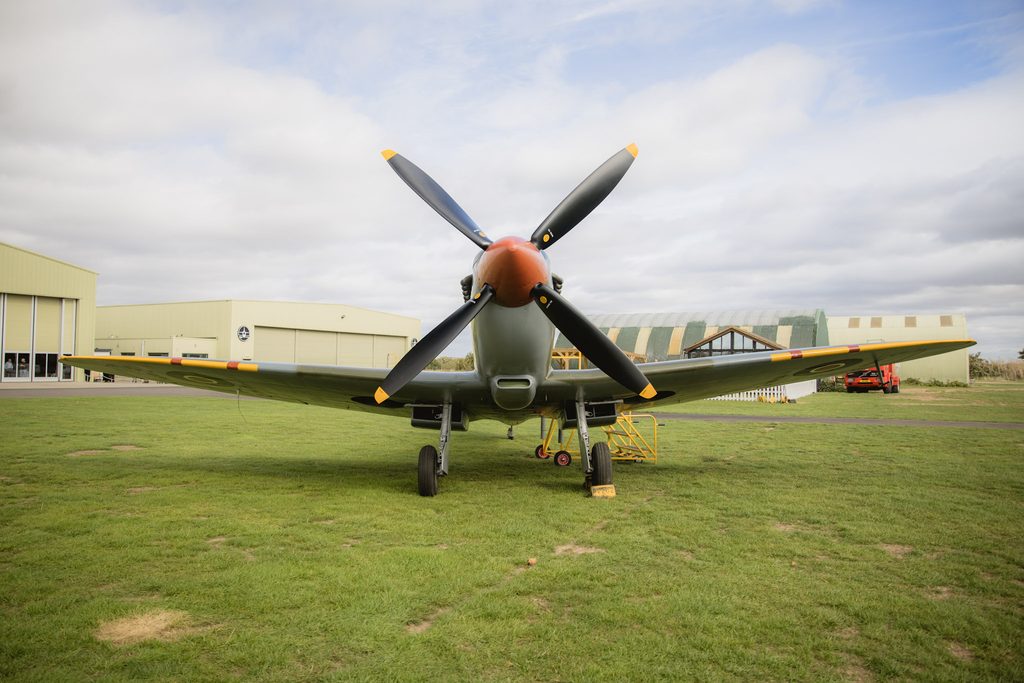
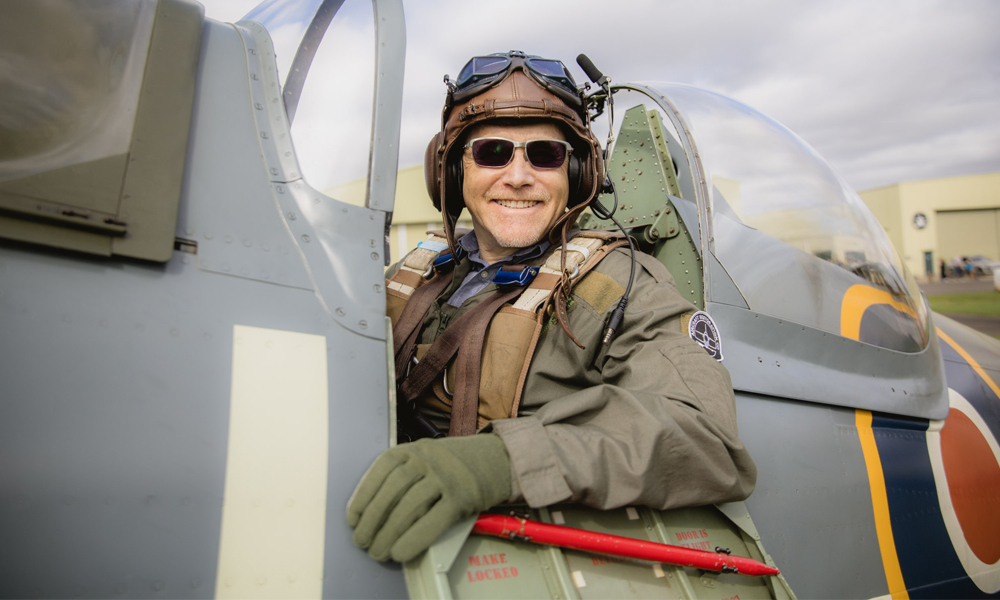
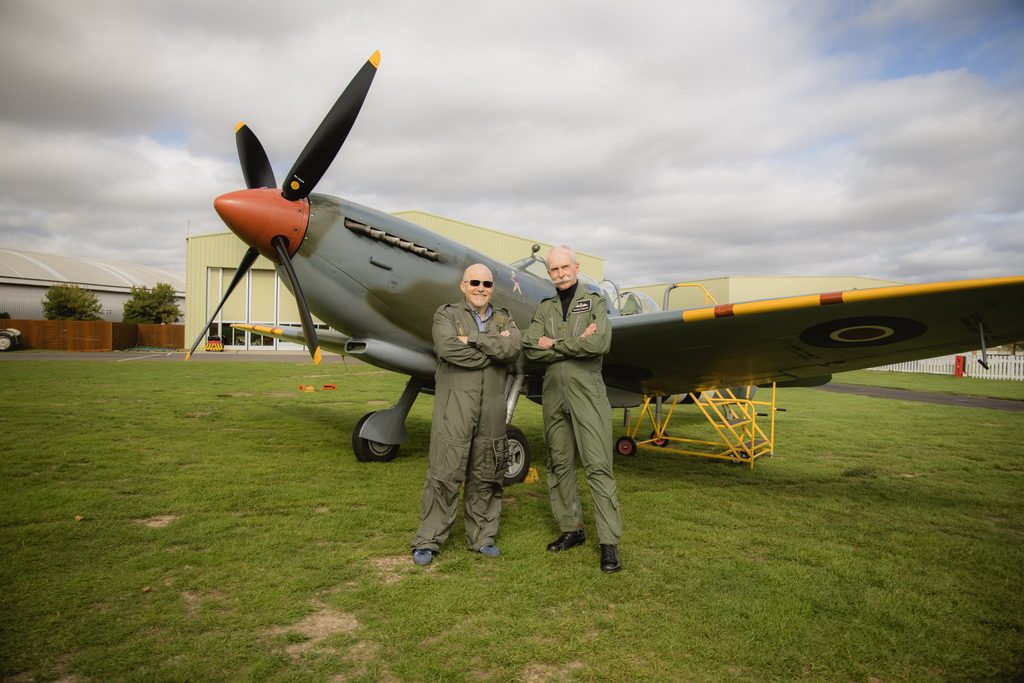
A Spitfire’s wingover goes something like this: you pull up, then drop the stick to the left, and the airplane does the rest. The instructor demonstrated the concept and said, “Ok, now you do one”. So, I took the stick, pulled up, and brought it back a touch further than I should have. At the top we went negative G (or as near to it as you can get with that many straps holding you in) and I felt myself rise in the seat. “You’re a little bit light there,” he said. “Try it again.” That was my first experience of handling a Spitfire and the controls took me by surprise. It’s so hard to describe how light and responsive they are: you ask for something small and you get it at once, and if you ask for a little too much, well – you get that, too.
I was up there due to a deeply appreciated 60th birthday present – my mother got me thirty minutes in a Spitfire, knowing it’s been a lifelong dream of mine (I know I only look half my age!). When I called to book, they told me that if I wanted to do any aerobatics, I’d really need a little longer. It wasn’t a dilemma – the thirty minutes immediately went up to forty-five.
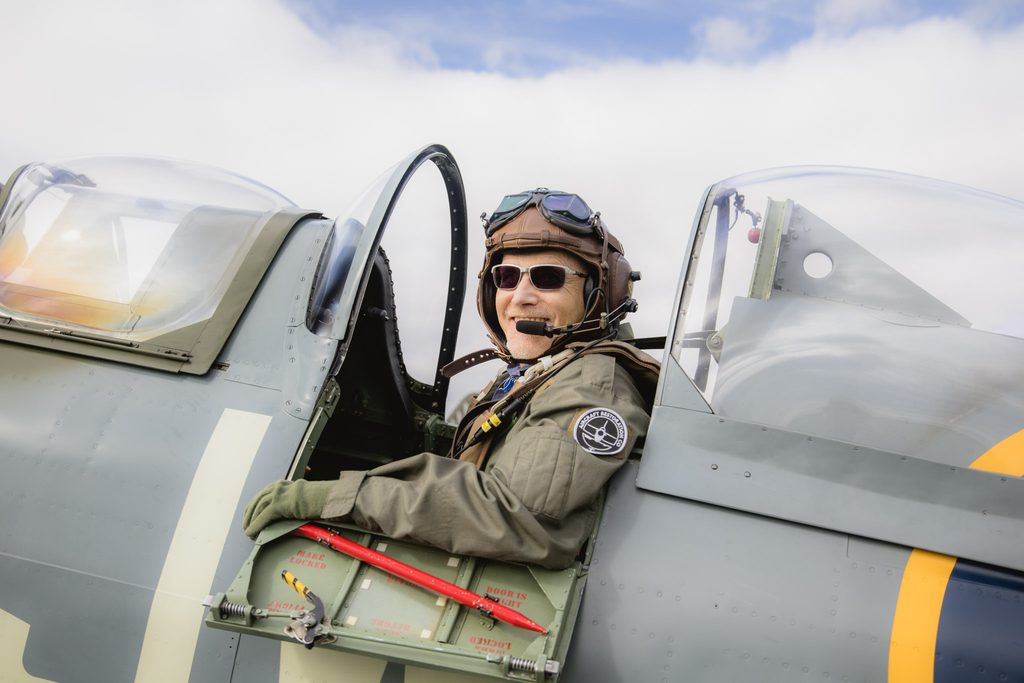
Duxford airfield is a place I’ve visited before – an old RAF fighter base north of London that’s now part of the Imperial War Museum. But it’s not a dusty collection of aviation relics – it’s more of a living history, bustling with aviation companies and organisations dedicated to the restoration of old aircraft. My Spitfire is owned by The Fighter Restoration Company* that spends most of its time rebuilding wartime fighters, sometimes from nothing more than a data plate and the original drawings. It’s a wonderful place to visit, even on days when you’re not pulling on a jumpsuit and a leather helmet for the ultimate demonstration of trust in their craft.
And, as amazing as the place and the people are, the pilot instructor was something else again. He had a handlebar moustache, a fantastic one, and with it he looked almost exactly like my dad, who’d been an accomplished RCAF fighter pilot. He even talked about the airplane the way my dad would have. Before we went, he asked whether I knew how to fly, and I said yes, my dad taught me. Did I know aerobatics? I said that I was rusty but yes, I did. “Okay,” he said. Once I was strapped in, he told me (in rather more colourful language than I’ll use here) to put my hands and feet on the controls and learn how to fly the thing. It sounded exactly like the way my dad would’ve said it – a surreal experience that made me feel immediately at ease with him.
So, I did. Two wingovers to the left, two to the right – some barrel rolls and a loop. Then he said that we had some time so why didn’t we go play in the clouds? “Cloud dancing”, was how he put it. The Merlin engine – twelve Rolls Royce cylinders – makes a wonderful sound. There’s so much power at the lightest touch that you never even play with the throttle; you simply do whatever you like. On the way home we did a victory roll over the airfield, and after we landed the canopy came open straight away to cool everything off. I couldn’t stop smiling.
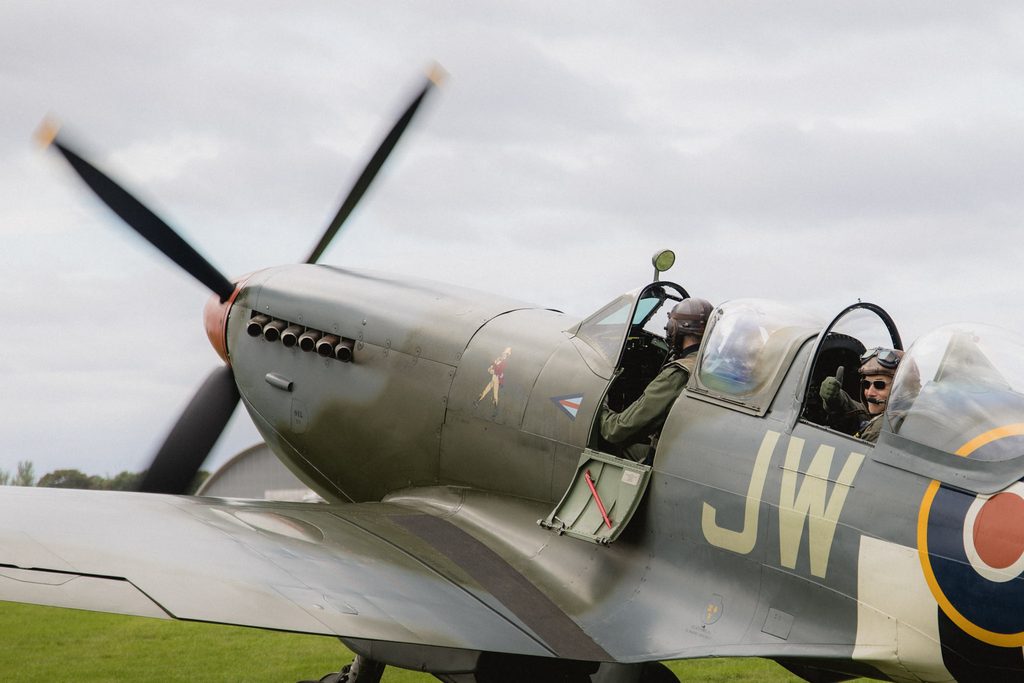
It was a wonderful experience for a nostalgic pilot and deeply satisfying for the engineer in me, too. I can’t help looking at how things are made, and this airplane rewards it. The cockpit is simple, with simple instruments that are meticulously maintained. However, they aren’t laid out in the T that every airplane has used for the last sixty years, so your scan is off until you get used to it. The gun button is a circle on the stick, positioned so your thumb falls on it. Obviously, I gave it a few presses just to see what would happen (nothing, unfortunately). The whole airplane is looked after beautifully and it’s evident from the moment you climb into the cockpit. The people responsible are the Fighter Restoration Company, a super cool group of guys who do nothing but restore and maintain old fighters. And, honestly, if I lived in England, I would work there for free.
That Spitfire is still flying purely because these people decided that keeping it in the air was the most fun they could have. You can’t get replacement parts anymore, but the drawings survived, so new parts can be machined again. And, somehow, Dunlop still has the tools to make tyres. The young man who walked me out to the airplane and gave me all my instructions was bright and enthusiastic. He’s a licensed aircraft maintenance engineer who spends his days around a Spitfire because he wants to, alongside people between 55 and 80 who carry a huge amount of knowledge. It occurs to me that the best way to teach an engineer is to let them feel the thing before they’re trusted with the buttons, and an airplane that answers when you touch it is a very good place to start.
But it made me wonder what, exactly, had made the experience so profoundly satisfying. Why would someone who spends his working life around some of the most complicated cabins in the world get so much from an airplane with a stick and a handful of simple instruments? Maybe it’s because it reminds me of where the knowledge starts – that we stand on the shoulders of those who came before and, like them, take our turn so the next generation can stand even higher. And I realised we all had something in common: me, the gentleman with the magnificent moustache and the young engineer with a passion for repairing Spitfires. Curiosity. That’s where the knowledge starts and that’s what we need to pass down: not just the information, but the drive to learn it.
I started out as an avionics technician and learning to fly was easier than I’d expected for the best reason: you finally understood what it all means. Forty-five minutes in the Spitfire felt a little like that again. Everything I know about aircraft was sitting in my head and, through my hands, the aircraft answered every small thing I asked of it.
A few days later I collected a brand-new Global 6500 at Bombardier’s Montreal production facility and admired the workmanship in it with exactly the same pleasure. None of the work I do now seems smaller from up there, and it impresses me as much now as it did the first time. It looks exactly what it is: a great many people going to enormous lengths so that someone, somewhere, can ask a machine for something – and have it do exactly that. But nowadays, there’s also a sadness about what we might have lost – the lessons that’ve faded over the years – that might have made it even better. And how it’s our turn to do what we can to preserve knowledge that might be more useful than we could’ve predicted.
After my time in the Spitfire – once we were back on the ground – I asked the pilot what one of these would cost. He shrugged and said, casually, “oh, about three or four million.” I laughed and asked him: “If I ever bought one, would you teach me how to fly it?” “Yes,” he said, “of course – it would be my pleasure,” and he smiled.
I think I’ve found a new lifelong dream. Regardless, I’ll be back there soon.
Thomas Chatfield,
November 2026
You can watch the video here: https://lnkd.in/p/g3AbWQ_W