
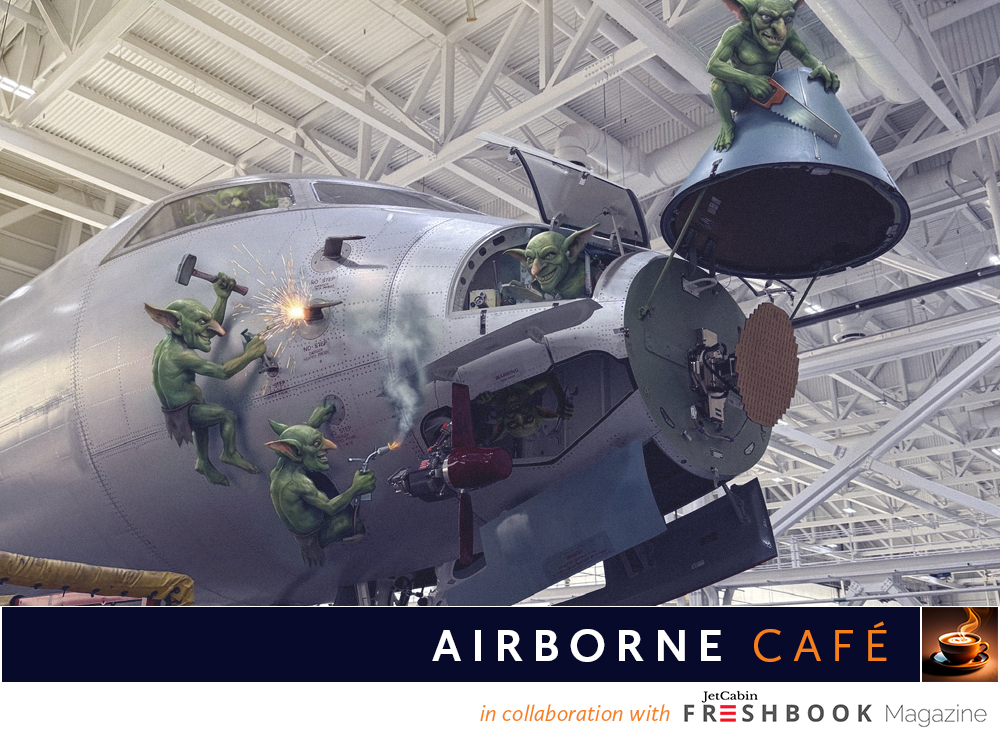
We see this pattern too often in aircraft completions: everyone’s doing their job well, but the programme still isn’t tracking the way anyone expected. No one dropped the ball or cut corners but somehow, delivery dates shifted or budgets moved in unexpected ways.
During WWII, aircrews found an elegant answer for this sort of problem: blame the gremlins. Not to shirk responsibility, but to acknowledge reality. When you’re exhausted, understaffed, and working under impossible pressure, things slip through the cracks. Gremlins became shorthand for that gap, a way of saying: this isn’t your fault, and it isn’t mine either. The situation is bigger than both of us.
That idea still holds up, but maybe the gremlins have outstayed their welcome.
Large-cabin completions are filled with talented people: designers, engineers, craftspeople, suppliers, certifiers. Everyone wants to deliver their piece well, but completions aren’t just complicated, they’re interdependent. Dozens of disciplines, hundreds of decisions, thousands of details all moving at once.
Most problems don’t come from people, they come from the gaps between them.
After overseeing many of these programmes, I’ve found the issues that cause the biggest delays and the costliest reworks invariably live in those gaps, not within any one discipline. Those are our modern gremlins, thriving any time coordination falls between defined responsibilities.
But those gaps don’t have to exist. They only appear when no one’s specifically watching for them, when the space between specialisms becomes a blind spot rather than a managed transition.
With independent oversight, there are no shadowy corners or fuzzy edges, everything stays in focus because someone’s looking across the whole programme, not just one part of it. The gaps close, and things run the way everyone intended. Independent oversight doesn’t exist to correct anyone, it exists to make sure there’s no room for the gremlins to creep in.
Here’s an example of how timelines might slip without anyone doing anything “wrong”:
You’ve chosen a completion centre. Designs are approved, engineering is underway and the start date agreed. The centre has slotted your aircraft into their production sequence. Orders are placed for cabinetry, seating, lighting systems, cabin management equipment, upholstery materials. Everything looks on track.
The aircraft arrives, is inspected and work begins on the systems and structural interfaces in preparation for the cabin. Bulkheads, ceiling panels and sidewalls are going in when it becomes obvious that the custom lighting assemblies won’t be delivered on time to support the outfitting schedule.
Your aircraft sits whilst parts are being manufactured.
Everyone has been doing their best, but the completion centre didn’t keep close enough tabs on a new vendor who was creating and certifying a brilliant new cabin lighting system (pun intended). The project management team took the vendor’s assurances at face value rather than actively monitoring progress to ensure everything would be delivered on time. From the completion centre’s perspective, a minor oversight severely impacted the schedule. From your perspective, it’s weeks of avoidable downtime whilst the real work sits idle.
Someone working across the whole programme could have locked in supplier timelines earlier, confirmed vendor progress and performed on-site visits of a new vendor to ensure that work was progressing as planned. There’s no magic, just coordination; but it only happens if it’s someone’s job.
Another all-too-common situation occurs when two experts aren’t given the right information at the right time. Like when talented designers and great engineers talk past each other.
As an example: your designer presents a beautiful bespoke seating arrangement that fits the client’s cabin philosophy perfectly without first confirming that this layout can actually be certified.
Then engineering review begins.
The envisioned seat tracking interferes with floor structure. The seat location results in limited seat recline due to its proximity to the emergency exit. The electronics are brilliant but create maintenance access issues: what should be a 30-minute component swap becomes a several-hour task.
Now you’ve got designers doing their best work and engineers doing theirs, but the two halves don’t align. Nobody’s wrong, they’re just coming at the same problem from different instincts: one from passenger experience, the other from certification reality.
What usually happens next is a compromise. The seat stays ‘bespoke’ in appearance, but the engineering underneath shifts back to something more standard. Its placement gets adjusted for certification. It works, it’s approved, but it isn’t the vision you originally signed off on.
With earlier coordination, this outcome’s avoidable as most constraints are predictable. Designing with the cabin constraints in mind could have preserved the design intent, but those conversations need to happen early enough that design and engineering can solve the problem together, not negotiate it after the fact.
Independent oversight is the translator to ensure those conversations happen whilst solutions are still flexible, not after everyone’s psychologically committed to an approach that won’t quite work.
Another potential “gap” (and one that’s a personal bug-bear of mine) is the specification document: a quiet source of loud problems.
A proper specification for a large-cabin completion can and should run over a hundred pages. Not because anyone enjoys documentation but because every line and specified detail prevents an assumption. And assumptions are where costs and timelines unravel. Yet we still see specification documents of ten or fifteen pages for multi-million-dollar completions. They’ll be supported by beautiful renderings, a material palette, a high-level description, great. But that’s a starting point, not a specification. Besides, all renderings have a caveat stating the actual cabin may differ from the rendering.
When a completion centre receives an underspecified project, they face an impossible choice: quote high to cover unknowns, or quote based on assumptions and hope those assumptions hold. Neither option’s fair. Neither leads to a predictable programme.
A comprehensive specification defines materials, tolerances, performance requirements, access considerations, certification constraints. All the considerations that make up the difference between being able to execute a vision or loosely interpret it.
Again, as with the other examples, none of this is about blame. Designers produce what they’re commissioned to produce; completion centres quote based on the information they’re given. But if no one’s tasked with building a detailed and complete specification then it simply doesn’t exist. The space it leaves behind becomes another entry point for gremlins to thrive. And whilst these slips or misunderstandings might seem like small hiccups in isolation, the ripples can cause giant waves if there’s nothing to interrupt them.
Completion sequences run in strict order: sidewalls and ceilings can’t be installed before the infrastructure is complete, cabinets can’t be installed before fabrication; final assembly waits on everything; testing waits on assembly; certification waits on tests.
So, if cabinet fabrication slips by a week because a supplier material arrives late, the whole sequence may shift. All the other phases: systems, upholstery, assembly, testing and certification, become a series of dominoes. That one-week delay can quickly become five weeks, even though everyone delivered what they were supposed to.
Could the materials have been ordered earlier? Could a secondary supplier have been on standby? Could parallel work have been rearranged to recover the time? Absolutely. But only if it’s been anticipated and someone has responsibility for it, a role assigned to watch the entire programme, not just one slice of it.
This is why independent oversight shouldn’t be seen as an impediment or a watchdog. It’s support, an extra layer of experience that helps coordination run smoothly and spots problems before they escalate. Client-first, certainly, but also a practical resource for every specialist in the programme.
Designers get early engineering feedback, so their concepts stay intact. Completion centres get clear specifications and fewer surprises. Suppliers get proper lead times. Certifiers get coherent documentation. The client gets a programme that feels steady instead of reactive.
Everyone’s job gets easier.
The complexity of a completion doesn’t disappear, it can’t. But with the right coordination, the noise settles. The project becomes predictable instead of chaotic.
So, to bring it all together: everything I’ve mentioned (the specifications, the vendor coordination, the sequencing, the translation between disciplines) flows into one single outcome: delivering the aircraft exactly as intended, on time and within budget.
That requires someone who understands the whole landscape, sees how the pieces interact, and knows where issues tend to show up long before they become visible. Someone who represents the client, respects the specialists, and closes the gaps that don’t belong to anyone else.
Because even when every team does excellent work (and they do), the gremlins still look for the borderlands: those places just outside a defined scope, just beneath an assumption, just beyond someone’s line of sight.
Independent oversight is simply the act of watching those borderlands. Not to criticise or second-guess, but to close the gaps before the gremlins find them, so the project can run the way it was always meant to.